Showing posts with label optics. Show all posts

Saturday, November 23, 2013

Electric blue icing


A glacier dripping down the cliff in Scott Inlet
Some time ago I promised I would write about the icebergs and glaciers I saw this fall along the Baffin Island coast and in Scott Inlet.

In every gap between cliff faces in Scott Inlet, tongues of glaciers dripped in slow motion like icing on a cake of grey cliff. These weren't glaciers that could be accessed by fancy-big-wheeled buses like Columbia Glacier or even easily reached to trek across like these folks did. I wouldn't want to try to get up to the main part of the glaciers as even without the dripping ice, the cliff-gaps would have required us to use ropes to successfully scramble up.

Glaciers flow under their own weight, a direction that is obviously down hill. I have no idea how long it took, but a few of the glacier tongues had made it to the ocean calving bergy bits into the water. The icebergs in the inlet were tiny compared to the big icebergs moving south along the coast of Baffin Island.

Along the coast, the iceberg that sank the titanic once passed more than a century ago. Even knowing before I arrived that I would be heading into iceberg waters, I was surprised at how many there were. Some looked large enough to dwarf an aircraft carrier (as a tangent: there was a proposal in World War II to make aircraft carriers out of ice). Some that had grounded could easily be mistaken for an island. Many had wave-rounded forms reminiscent of modern sculpture, or ancient weathered architecture.

An iceberg glowing blue
What fascinated me about the glaciers and icebergs was their colour. Even under the grey skies parts glowed electric blue – almost like they were generating their own light deep within. Glaciers and icebergs don't actually glow, but under the right light it looks that way.

Snow looks white because of all the reflective edges from the layers of snowflakes. Once the snow is compressed into glacier, the edges merge and air is pushed out. However, any ice can look blue in time. Like the reflective snowflake edges, air bubbles scatter all the wavelength of light making young ice look white. Older ice looks bluer because air bubbles and other impurities have been pushed out.

Like water, ice absorbs the longer wavelengths of light as it passes through. That is, the red end of the spectrum is absorbed first, which is why a short distance underwater the seascape is dominated by blues and greens. Ice has the same effect on light, it filters colours as light passes through leaving blues. And it appears to glow because those blues have passed the whole way through – so the ice looks bluest from the inside.

Tuesday, September 4, 2012

Examples of iridescence from the fall fair

I caught these two beauties showing off their iridescent plumage at the fall fair. It always amazes me that such a range of colours can be produced from an optical trick.

Friday, May 13, 2011

Water on the road?

Desert travel stories take a dramatic turn for the worse when the hero rushes towards what appears to be an oasis. When she arrives, despair sets in as the inviting waters vanish, revealing more hot, dry sand. I've never seen a desert mirage, but on hot days, I've seen what appears to be shimmering pools of water on the road – only to drive closer to find the road is dry.

Mirages aren't a hallucination of dehydrated desert travelers, instead they arise from atmospheric optics. Remember how light bends when it passes from one medium to another? The refracted light is bent if the mediums are of different densities – mirages occur when light passes through many layers of air with different densities.

On a hot, sunny day, sunlight heats up the ground. This heat radiates, heating a layer of air right next to the ground. The next layer up also heats up – but not as much. The result is a gradient of heat with hottest air next to the ground and cooler air further away. Since the density of air depends on its temperature, hotter air is less dense than cooler air. So, in our sunny day example, the least dense air is closest to the ground (an unstable situation only persisting as long as the ground is being heated up). Which means the refractiveness of the air is less at the bottom than the top, so the light bends towards the cooler air.

Sunlight entering this temperature gradient at a shallow angle to the horizon is bent slightly differently by the different density layers. At first, it successively bends into shallower angles because each layer was less dense. At some point, the angle becomes so shallow light reflects, turning upwards, but still at a shallow angle. As this light travels back through the now progressively denser layers it's bent the opposite direction and the angle to the horizon would increase. Eventually, an observer's eye is reached – the poor hero in the desert or me driving my car.

So, a mirage is simply light refracted and reflected from the sky. Since sky reflections on the ground are typically indicative of water, our brains interpret what we see as a body of water.

I've described a static scenario, but in the real world hot, less-dense air rises, heating of the the ground is uneven and turbulence will form – all acting to make the mirage shimmer.

Wednesday, April 13, 2011

Why is glass transparent?

Sitting at my desk, I can look out onto my backyard through sliding glass doors. So why can I see my backyard at all? That is, why is glass transparent? We take the clearness of glass (and plastics) for granted, but this property is incredibly important. Seeing the birds in my backyard may not be critical, however, seeing oncoming traffic when I'm driving my car is. Allowing light into my home through windows saves the energy required to illuminate my home so I wouldn't walk into things. Think of the deli case at your local supermarket – the glass allows you to see the goodies inside, but protects them from the other customer's germs.

I wrote about the history of glass here, however, the fact that glass is clear likely kept us using it for so long. For example, my house would be a lot more secure from break-ins if I replaced all the glass windows with steel plates. Two physical properties play a role in making something transparent, the object itself and its sub-atomic makeup.

Transparency to visible light is common in the stuff around us -- For example, air and water. In fact, many gases and liquids are transparent because their structure isn't rigid, leaving plenty of room for light to pass through. However, solids don't tend to be transparent because they have a tighter, more orderly structure, making it harder for light to pass through. Glass (and clear plastics) are made by heating their components, mostly silica sand, into liquid form and then allowing it to cool. As a result, glass is rigid like a solid with a random structure like a liquid making it possible for light to pass through.

Light acts both as a wave and a particle. If we consider light as a particle, which is called a photon and contains a certain amount of energy, it can interact with the electrons in the matter around us. When a photon encounters an electron the following may occur:

1.The electron absorbs the photon's energy and vibrates a little faster – that is, the photon's energy has been converted to heat.

2.Again the electron absorbs the photon, but this time it stores the energy and re-emits it later, a phenomenon called luminescence. Think of an analog wrist watch (remember the ones with a two arms and a circle of numbers?). Often the numbers were painted with a substance that would absorb light and glow, allowing you to see the time in the dark.

3.The electron can absorb the photon then re-emit it back in the direction it came from. This is reflection and is why you can see your image in a mirror.

4.Finally, the electron may not be able to absorb the photon at all, so the photon just passes by.

These electron/photon interactions can all occur within a single substance, or some combination of them. If only case 4 occurs, that is the electron's within an object can't absorb a photon in the visible light spectrum, that object will appear transparent. Glass has this property, which is why it makes great windows.

As a tangent, glass absorbs much of the UV spectrum which is why you can't get a tan behind glass.

Friday, April 1, 2011

Let me be clear... a bit about glass


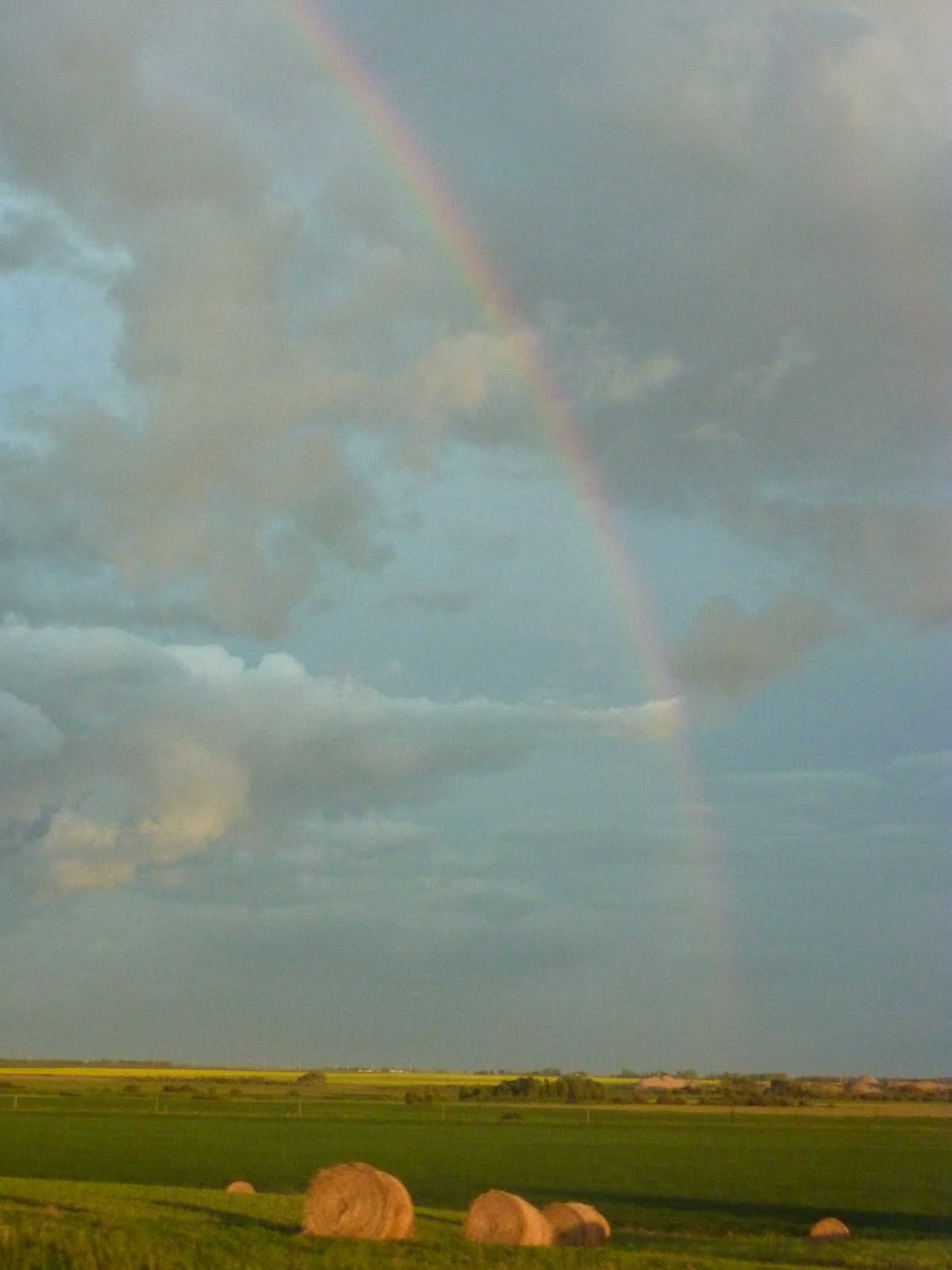
I found a photo I took of a rainbow last summer when we drove across Canada. I took it from a moving car (I wasn't driving) - so it isn't as fantastic as it could be.

I've been thinking about Theodoric of Freiberg's rainbow experiment (I wrote initially about it here). He used a spherical glass filled with water to approximate a rain drop and a piece of parchment with a pin hole in it. By shining light through the parchment hole and onto the glass sphere, he was able to observe the result of raising and lowering the sphere. From this he explained all the colours of a rainbow. So his glass sphere must have been essentially perfect for this to work, and he wasn't the only one using these sphere's for optics experiments. So how did we get so good at making glass? (the extremely short version)

Glass making is an old art, by about 1500 BC the Egyptians were making glass vessels and soon after the Phoenicians mastered the art and began exporting glass goods all over. However, the Romans with glass blowing (likely invented by the Phoenicians), put cheap glass vessels into their citizen's homes. Romans went on to adapt glassblowing for making glass windows for some of their buildings – not widely done because they lived in a warm environment. Roman windows were made by blowing glass into a bulb shape, then manipulating it into a cylinder shape. The cylinder was split open lengthwise before being re-heated and forced flat. One of the largest windows made of this method was found in Pompeii measuring just over a metre wide.

So, the Romans weren't hugely into glass windows, but after they were gone, those who lived to the north took up interest in them. The technique used became simplified to blowing glass into spheres and then cutting them while still hot into the shallow bowls of 'crown-glass' windows. Additives of different minerals result in brilliant colours for stain glass windows. Since, churches were one of the few places rich enough to afford glass windows and they wanted to tell stories through cut coloured glass put back together, large sheets of uniform glass wasn't necessary.

Throughout medieval times, rich folks were drinking out of blown glass and keeping the weather at bay with blown glass windows. So by, Theodoric's time in the fourteenth century, glassblowing had been around a long time. If an artisan can make a nice wine glass, certainly that skill could be put to use for scientific instruments.

Wednesday, March 30, 2011

Rainbows

As a continuation of my optics theme, I thought I'd take a look at rainbows. I usually see them when I'm driving (which is why I have no photos of them). The half-sunny, half-rainy days rainbows need usually are threatening to soak me, so I do indoor activities instead.

Since antiquity, people have wondered about rainbows. Why did they form? What did rainbows mean? Some believed they were an omen of some sort, as in “should we look at the end for a pot of gold?” On the flip side, reasonable scientific explanations have been around to explain rainbows for quite some time. Theodoric of Freiberg (1250-1310), is one of the first Europeans to have come up with an explanation for why rainbows form based on his experiments (his work was based on that of an earlier Arab scholar). He managed to explain, before a solid theory of refraction was published, the rainbow's colours, its position, and how it forms from multiple rain drops. Since then, others have refined his explanation.

Rainbows form from refraction and reflection within millions of raindrops. And size does matter for the rain drops, optimum results occur for drops in the range of 0.3 to 1 mm in diameter – this is why rainbows formed on mist are so much more subdued, the raindrops aren't big enough to generate brilliant colours. Along with the rain, a strong light is needed – usually sunlight, but a bright moon can also form a rainbow (something I've never seen but sounds cool).

As sunlight hits a rain-drop, it's bent slightly (refracted) and the colours spread out. Against the back surface of the rain drop, the light is reflected then it passes out the front surface, again bent slightly. So, to an observer, the resulting light will appear a certain colour based on what angle the drop is viewed at. Violet light emerges from a drop at 40 degrees to the incoming light and red at 42 degrees, with the rest of the spectrum ranging between.

From this same effect occurring in millions of different drops simultaneously an entire spectrum of colours can be seen, remembering that each drop only produces one colour for a stationary observer.

As a tangent, rainbows may be able to form on Saturn's moon Titan.

Tuesday, March 1, 2011

Good stripes, bad stripes

Stripes have been viewed in a variety of ways through time. I would have thought that as soon as people invented the loom, stripes would have followed. Stripes must be one of the easiest patterns to make – yet medieval western Europe shunned them.

Stripped clothing was considered at best demeaning and at worst downright diabolical. On the other hand, dots, discs, stars, rings and other simple repeating patterns were good – even viewed as expressing something majestic. This distinction between good and bad patterns was even applied to the animal world; horses were good and zebras were bad. Fortunately, our views about stripes has morphed with time and I can sleep in striped pajamas without worrying about my soul.

Although stripes can't tell us anything about the wearer's moral character, they can tell you what something is made of – even from a distance. Here is a rough idea how it is done (yes it's another optical trick).

Remember Newton's classic experiment where he shone light through a prism and got a rainbow coloured spectrum? If you look really, really closely at the spectrum you can see hundreds of irregularly spaced, thin, dark stripes, which is exactly what the German scientist, Joseph von Fraunhofer, did in 1814. Today, we know more than 30,000 of these lines exist in the sun's spectrum – but what are they?

Elements, like oxygen, helium and the others on the periodic table, are fundamental. They can't be broken down into smaller parts without taking extreme measures like using a super-colliders. If you shine a light (assuming this light gives off a perfectly continuous spectrum) through a gas of an element, then let the light go through a prism the resulting rainbow will have dark stripes in it. These stripes are called absorption lines and are unique to the element. So the stripes from helium will look different that the stripes from nitrogen. This means that, an element can be identified from its stripes alone.

So all those stripes in the spectrum of the sun tell us what the sun is made of – without having to go there.

References:
Universe, 5th edition by William Kaufmann and Roger Freedman, W.H. Freeman and Company, New York, 2000.
The Devil's Cloth: a history of stripes and striped fabric, by Michel Pastoureau, Columbia University Press, 1991

Friday, February 25, 2011

Buckets of water

I was asked why a bucket full of water looks shallower than an empty one, so I pulled out an old physics book to find the answer. It's been many years since I've taken optics, although recently I've developed a new interest for it.

Refraction occurs because the speed of light changes based on the density – something I discussed here. The refractive index is the ratio of the speed of light in a vacuum to the speed in the medium. If we think about water with its refractive index of 1.33, we find that light travels 1.33 times faster in a vacuum than the water. The denser the medium, the greater the difference in speed of light and the bigger the refractive index.

Not only does light slow down, it also bends. When a ray of light hits a surface at an angle (angle of incidence) it gets bent to a new angle (angle of refraction) inside the surface. With a little trigonometry applied to these angles, we find that their ratio is also the refractive index, a trick discovered by Willebrod Snellius (of Snell's law fame) in 1621 – although an Arab scientist figured this out almost 500 years earlier.

So, what fun can we have with the refractive index? Ever looked into a still pool of water? Due to light rays bending in the water, the pool will look ¾ the depth it actually is. If a post sticks up through the water, it will look oddly disjointed at the surface – appearing to extend at one angle above the water and another below the surface even through the pole is straight.

From another point of view, what does a fish see when it looks up? A fish sees a lot more than expected. By looking up in a cone of 98 degrees, a fish gets a 180 degree view above the water due to refraction. The view above the water would be strange – someone fishing on the shore would look excessively squat, standing at an odd angle and probably distorted due to ripples on the surface. But, the fish would see the fisherman, making it much more difficult to be successful at fishing (spear fishing is even more complex due to refraction). By the way, if you put on your goggles and hopped into the local swimming pool, you would see what the fish sees.

Sunday, February 20, 2011

The physics of salad dressing

Ever made your own salad dressing? For a vinaigrette, ever wondered why the result is opaque even though most of the ingredients are clear? Vinegar is typically clear, as is oil – a trick of optics makes the results opaque, which is easily demonstrated at home (In case you want to check this one out for yourself).

Put oil and water (as a stand in for the vinegar) together in a jar (see picture). Oil floats on water with an easily seen interface. The background of my blue cutting board shows through for both layers. Vigorous shaking of the jar creates a emulsion of the two liquids. An emulsion is not the same as mixing, since the oil and water don't actually mix. Instead, both liquids form tiny bubbles that co-exist beside each other – over time they would separate back out into two layers. Once the emulsion forms it become opaque (see picture number 2).

An opaque liquid like mud (tiny dirt particles suspended in water) operates differently – mud's opaque because it absorbs much of the light incident upon it. Our oil and water looks opaque because of back reflection. Each tiny drop of oil and water remains clear. Now gizillions of surfaces form, separating the oil and water and each interface reflects light. Since the drops are round, the light isn't reflected perfectly back where it came from like a mirror, instead it scatters in all directions. This scattering creates a matte look to the emulsion – like the look of white paper.

As a tangent, under high magnification, white paper consists of random criss-crossing fibers that also scatters the light incident upon it. So a vinaigrette and white paper have something in common.

If you sit your vinaigrette on the counter for a few moments, the two layers will reform quite quickly. To keep an emulsion emulsified for a longer period of time, an emulsifier can be added. Mustard or honey are often added to vinaigrettes for this reason and their tastiness. Egg yokes can also be used and they typically act as an emulsifier for mayonnaise.

Thursday, February 17, 2011

fabrics with a fishy twist

Since I love the effect of structural colours, when I came across a story that could have me wearing them a few years from now, I had to share. Check out this.

Tuesday, February 15, 2011

A flash of green

The spectrum of sunlight peaks in the green wavelengths (520-570 nanometers), explaining why most plants are green: an attempt to optimize the available energy for photosynthesis. Our vision's colour sensitivity also peaks in the greens – the better to hunt green vegetables. With so many greens surrounding us, it would be easy to overlook a rare optical phenomenon in the sky: the green flash at dusk.

Just after the sun's final moment in the sky, a flash of brilliant green may be seen for a brief moment, but - only if the conditions are exactly right. A corresponding flash of green may occur just before the sun rises over the horizon. I've never been lucky enough to see either of these phenomenon. I assume folks saw this flash as soon as they started looking at the sky, however, the first conclusive scientific sighting occurred in 1865 by W. Swan. He described the sight as a 'dazzling emerald green' flash at sunrise. In 1926, a PhD thesis was written on the topic by P.F. Keuper. As I haven't been able to find a copy, I don't know if he found it dazzling or not.

Atmospheric refraction causes the green flash (although other not yet understood phenomenon may be involved). As we know, sunlight is composed of many different wavelengths. In the vacuum of space, all wavelengths of light travel at the same speed (the speed of light, a speed we cannot exceed). Once they hit the atmosphere, some wavelengths are absorbed and some pass through. For now, let's consider the visible spectrum as most of it passes through the atmosphere without being absorbed.

Since the atmosphere is contains more stuff than the vacuum of space, when light enters it slows down. If the incoming light hits the atmosphere straight on, all the wavelengths pass through, albeit at a slightly slower speed. At an angle, the light is forced to bend as it enters the atmosphere – an effect called refraction. This allows us to see things slightly over the horizon, like a ship, because light is refracted the same direction as the earth curves.

The amount light slows differs for the different wavelengths resulting in slightly different bent angles. Higher frequency light (blue/green) bends more than the lower frequencies (red/orange). In the extreme angled case, like a setting sun, the sun's image separates by colour (difficult to see because the sun is so bright and dangerous to look at). If you could slow the sunset down, first red would set, followed by yellow, then green with a remaining glint of blue/violet. Typically, just a flash of green is seen, or if the conditions are exceptional a flash of blue.

If you are setting out to see a green flash, the ideal conditions include a sharp horizon (ie, far away from buildings), perfectly clear air (get even further from those buildings) and a homogeneous atmosphere (a remote desert might work).

For more info, check out wikipedia or Sunsets, Twilights, and Evening Skies by Aden and Majorie Meinel (1983), or The Field Guide to Natural Phenomena by Keith Heidorn and Ian Whitelaw.

Friday, February 11, 2011

Bubble colours

Who hasn't blown bubbles outside on a sunny day? If you haven't, devote some time to blowing bubbles the next time the sun is out - it's fun. As a bubble floats gracefully through the air, sunlight creates a virtual rainbow (actual rainbows are formed by a different process) of colours across the bubble's surface. The colour-making phenomenon at work is the same as what creates the colours on a slick of oil, a rooster's tail, a cardinal tetra or hummingbird's gorget – it's iridescence.

Bubble walls are constructed of several thin layers, two soap layers sandwich a layer of water between them. This wall encases a volume of air. As sunlight shines on a bubble, some of it reflects off the surface and some enters the soap film. Inside the bubble wall, light travels slower because both water and soap are denser than the air. At the interface between the soap film and the water, again some light reflects and some passes through. The reflected light may bounce back and forth between the two surfaces a few times or it may just pass back out of the bubble. Reflection or transmission of light occurs at every interface. Most of the light emerging from the interior of the bubble wall will be out of phase with the light that reflects off the interface. Out of phase means that the troughs from one wave line up with the crests from another so that the waves cancel each other out. Some of the emerging light will be in phase, that is, the crests and troughs line up with each other. These two light waves amplify each other, resulting in brilliant iridescent colours.

Layer thickness determines what wavelengths (thus colour) will be amplified. If you move and look at the bubble from a different angle, the colours will change. This is because your viewing angle has changed in relation to the layers. From different angles the distance the light has to traverse to reach you changes, thus the wavelengths that amplify each other also change.

Unfortunately, soap bubbles last only a short time. It doesn't take long before gravity pulls the liquid to the bottom and evaporation whisks fluid away. Bubble colours change as the bubble changes. When the bubble walls are thick, only red gets canceled out leaving blues and greens. As the walls thin, yellow is also canceled out leaving blue. Next green is removed and the bubble looks magenta. Blue goes last making the bubble look golden yellow. As the bubble wall's continue to thin, all the waves in the visible region cancel out and the bubble looks just clear. When the walls reach about 25 nanometres thick the bubble is in serious risk of popping.

Since the thickness of a bubble's walls aren't constant - the walls thicken towards the bottom (remember gravity acts to pull the water down), bands of colours seem to fall downwards on the surface. That pesky gravity also prevents us from dyeing bubbles. The dye will only mix with the water and drain to the bottom of the bubble. However, when gravity is absent dyeing bubbles becomes possible – so if you head out on a long voyage to Mars bring lots of bubble making supplies as you'll have years to perfect your bubble dyeing technique.

Sunday, January 9, 2011

Insect wings


I'm fascinated by iridescence - I wrote about it here and here. A recent study of the iridescence of insect wings when viewed against dark backgrounds was conducted and the resulting pictures are fantastic. Check it out here or here.

Here is a photo I took yesterday of my jar experiment (I started it here). I'm now eleven days in and the water inside the jar still looks slightly yellow. I don't think there has been any change so far. Perhaps the jar should be moved into direct sunlight (which isn't possible in my office).

Wednesday, January 5, 2011

Another type of scattering

Clouds are mists drawn up by the heat of the sun, and their ascension stops at the point where the weight they have gained is equal to their motor power
- Leonardo da Vinci

The weather has changed outside. We had almost a week of beautiful but cold, sunny days. Now, clouds have rolled in, changing the sky from beautiful blue to drab gray. Have you ever looked up at a cloudy sky and wondered why the clouds are white? Alternately, have you ever looked at the foam of a dark beer and wondered how the foam could be white while the beer is dark? The answer lies in how light interacts with water droplets in clouds and tiny bubbles in beer foam.

The average size of a water droplet is between 0.01 and 0.02 mm, with the largest ones about 0.15 mm (from 'The Field Guide to Natural Phenomenon' by Keith Heidorn and Ian Whitelaw) and they are transparent. Cloud colour results from an optical phenomenon. Since water droplets are similar in size to visible light wavelengths, when light passes through the water droplets all wavelengths are affected the same way. This optical phenomenon is very different to the preferential blue scattering from gas particles in Rayleigh scattering that make the sky appear blue. The effect of scattering each wavelength of light in the same way is called Mie scattering after Gustav Mie, the German physicist who figured this out (there are others who independently came to the same conclusion but didn't get the phenomenon named after them). In Mie scattering all wavelengths scatter equally, making clouds appear white since all the wavelengths are present in the same amounts. In a thick bank of clouds, no direct light makes it through; instead all colour results from diffuse radiation. Thick clouds may appear in menacing shades of gray.

The foam atop of a freshly poured beer is composed of uniformly sized bubbles suspended in beer (from 'Does Anything Eat Wasps? And 101 Other Questions' edited by Mick O'Hare). Each tiny bubble is filled with air with a lower refractive index than the liquid around it. As a result, the bubbles act like magnifying glasses in reverse, where light that enters the bubbles is scattered in different directions – another example of Mie scattering. Reflections off the bubble's surface adds another layer of scattering. Both scattering effects created by each bubble is compounded in the foam. Since each wavelength of light is affected the same way, the fraction of light that makes it out will appear white, that is all wavelengths are equally present (The end result might be slightly yellow if the beer surrounding the bubbles absorbs some of the light).

Light hitting dust, smoke or pollen can also experience Mie scattering. This effect also explains why milk is white.

Friday, December 3, 2010

Part 4: Blue Eyes


Here is part 4 of my 4 part series on nature's blues. Part 1 is here, part 2 is here and part 3 is here.

Gaining an understanding why something is the way it is in nature is not always a direct path. We know the blues found in nature are often the result of the object's internal structure rather than pigments, however the actual blue making process can vary. Although the blue of the sky and the blue of a feather can look like the same colour, the actual mechanism involved is very different. The two optical phenomenon involved in making these blues are Rayleigh scattering and coherent scattering. The blues produced either way can look the same.

So, which of these mechanisms is responsible for blue eyes? Rayleigh scattering is the culprit this time. Eyes appear blue when there are only small amounts of melanin present in the iris. Melanin is the pigment that makes the iris brown – a complete lack of melanin results in the pink eyes of an albino. When light passes into an minimally pigmented iris, tiny protein particles in the eye act just like the gas particles in the atmosphere blue wavelengths are preferentially scattered and the eyes appear blue.

As a tangent – here is how Leonardo da Vinci explained blue skies 200 years before Lord Rayleigh:

'I say that the blue which is seen in the atmosphere is not its own colour, but is caused by the heated moisture having evaporated into the most minute and imperceptible particles, which the beams of the solar rays attract and cause to seem luminous against the deep intense darkness of the region of fire that forms a covering among them.'

Monday, November 29, 2010

Part 3: Blue Feathers


Here is part 3 of my 4 part series on the scattered blues. Check out part 1 here and part 2 here.

Blue feathers have evolved in many species of birds. A blue jay's plumage is an excellent example with blue and white. You can see the black and blue of a Steller's jay in your own backyard. A male mountain bluebird has blue plumage of this type along with the head feathers of the male lazuli bunting; both can be found in central British Columbia. We know that feathers don't contain blue pigment, so the colour must be a result of the feather's structure.

In the late 1800s, just after the discovery of Rayleigh scattering, naturalists used this new concept to explain why blue feathers were blue. Since they didn't have the tools to examine the nanostructure (structure in the order of a billionth of a meter) of a feather, naturalists assumed that within the feather there existed transparent cells full of particles that were tiny enough to create Rayleigh scattering. Like the sky, blue light would be more efficiently scattered. These transparent cells would also contain pigments to absorb the longer wavelength colours. As a result, to our eyes these birds would appear blue.

Because Rayleigh scattering is incoherent, it produces the exact same colour irregardless of the observation direction. Since blue feathers in natural light don't change colour depending on what direction the naturalists looked at them, the assumption that their colour was formed through Rayleigh scattering seemed valid. But, in the 1930's, scientists examined a a non-iridescent blue feather under a directional light source. Colour variations were observed as the light source was moved – an iridescent characteristic that called into question the hypothesis of Rayleigh scattering making the feather blue.

By the 1940's, a cool new gadget came on the market – the electron microscope. Now naturalists could directly examine the internal nanostructure of blue feathers. Based on this first look, they interpreted the internal feather structure to contain randomly spaced objects. This meant scattered light would be incoherent leading giving support to the hypothesis of Rayleigh scattering. It took decades of further research to change this hypothesis and in the mean time many textbooks were written explaining that blue feathers were the result of Rayleigh scattering. By the 70's, scientists finally determined that the nanostructures were, in fact, not fully random. Instead they were a quasi-ordered matrix – not quite the perfect order of iridescence but not the full randomness required for Rayleigh scattering. Under natural light from all directions, like sunlight, these feathers appear to be the same colour from all directions. However when a directional light is shone on blue feathers the colour will change depending on the light direction.

Since the colour of a Steller's jay's feather comes from its internal structure on a tiny scale, a damaged feather would lose its blue colour. The dark pigments in the feather, that act to help show off the blue, would make damaged feather would look almost black. So if you are lucky enough to find a Steller's jay feather, take care of it.

Thanks to G. Hanke for the photo of mountain blue birds.

Saturday, November 27, 2010

Part 2: Blue Skies


Here is part 2 of my 4 part series on the scattered blues. Check out part 1 here.

On a sunny day, we perceive blue blanketing the sky, but, in reality, the sky has no colour. When traveling towards us, sunlight first hits earth's atmosphere. Earth's atmosphere is primarily composed of nitrogen (78%) and oxygen (21%) with bits of dust, water vapour and some inert argon, among other things. Water vapour and dust are the physically biggest components of the atmosphere, and are relatively large compared to the wavelengths of light. When light hits the water vapour and dust, is reflected in different directions, but the light remains white. So why does the sky appear blue?

In 1810, Goethe gave this explanation: “If the darkness of infinite space is seen through atmospheric vapours illuminated by the daylight, the blue colour appears.” His theory said colour comes from something within the atmosphere during the light of day. About the same time a more scientific inquiry was being made into the nature of scattering light. John Tyndall showed in an 1869 lab experiment that the blue hues of the sky could be created when white light was scattered by tiny particles. A few years later in 1871, John William Strutt, also known as Lord Rayleigh, was the first to describe the actual mechanism that makes the sky appear blue was a result of the tiny gas molecules of the atmosphere instead of the larger dust and water vapour.

When light collides with a gas molecule the results are different than when light hits a relatively large dust particle. Gas molecules are tiny compared to the wavelengths of light – several thousand times smaller. When light strikes a molecule, that molecule absorbs a specific wavelength (or colour) of the light's energy and later re-emits the same colour in all directions; a process called Rayleigh scattering. This type of scattering is an example of incoherent scattering. Lord Rayleigh discovered that molecules absorb energetic light (blues) at a much greater rate than less energetic light (reds).

Most of the longer wavelengths of light pass through our atmosphere unaffected, resulting in the full spectrum of sunlight with a higher ratio of blue wavelengths from the scattering. For this extra blue light to make the sky appear a brilliant blue, a dark background is required. Fortunately, beyond our atmosphere is the blackness of outer space, which makes an ideal dark background. The combined effect of the extra blue light and the black of outer space results in a sky that appears blue.

If you shift your gaze towards the horizon, the brilliant blues give way to paler colours and perhaps even white. The light reaching you from near the horizon passes through much more atmosphere, so the scattered blue light is scattered again and again, reducing its intensity. This is another consequence of Rayleigh scattering. Preferential scattering of blue light by our atmosphere occurs everywhere, not just above us. For example, light reflected from your hand to your eye is affected by this scattering, but the effect is so minuscule we can't detect it. Over a longer distance, like to a range of distant mountains, there is enough atmosphere to superimpose a blueish haze on our view of the mountains.

Friday, November 26, 2010

Part 1: Blue Skys and Blue Feathers – The Scattered Blues


A while back I wrote about why the sky was blue and why some feathers are blue (here) – well I didn't quite get it right, so I'm trying again. I've written a more detailed explanation which I'll post in four parts.

When I look around, I see lush greens of temperate rain forest, rich browns of fertile soil, lively yellows in fluttering butterflies, and luscious reds in ripe berries – but, not a lot of blues. If the sky is clear, it's the biggest blue object around, extending from horizon to horizon. Water reflects the blue of the sky, adding another layer of blue. On a lucky day, I'll catch a glimpse of a Steller's Jay showing off it's blue and black plumage, or a shimmering silver-blue dragon fly will dart by. I might even see a rare blue flower. On a gray winter day, the blue eyes of my favorite companion may be the only brilliant blue around. Other natural places have their own blue components, but in general, blues aren't common in nature. In fact, world-wide there just isn't a lot of natural blue pigments, thus the blues we see are often the result of optical properties within an object. These colours created as the result of an object's structure are called, creatively, 'structural colours'. Blue is a very common structural colour, and to understand why we'll need to start with some optics.

Sunlight is called 'white light' because it appears colourless. Within this colourless light lurks the full colour spectrum. Once, people thought white was the fundamental colour of light, and colours formed when something was added into the light. This theory was changed after the careful experimentation and observations of Sir Isaac Newton. Around 1670, Newton shone light through a prism creating a rainbow of hues on the other side. From this result, he concluded that white light contains all colours and that the prism simply separates them. Therefore, colour results from interactions between an object and light.

We now understand that white light is made up of tiny waves (which are simultaneously tiny particles if you want to add complexity). Light waves travel at the same speed but can have different wavelengths, that is, the distance between successive crests. Our brains perceive the different wavelengths as different colours. The longer wavelengths form reds, oranges and yellows, and the shorter wavelengths form greens, blues and violets. If you could watch waves of light pass by, more waves of blue would pass compared to waves of red – this means that the blue light has more energy. Light travels outward from its source, the sun, in a straight line until it collides with something. This collision could release all the hues in the spectrum or just a select few.

Scattering describes how light is diverted from its original straight path. Light scatters in two ways: coherent and incoherent. When scattering is coherent, spectacular effects such as iridescence can occur. Like a ball bouncing back from a flat wall, the light reflects precisely because the reflecting surface is geometrically regular. Similar colour light waves augment each other, further intensifying the effect. An iridescent feather's colour can change depending on viewing angle, a phenomenon easily observed in a Anna's Hummingbird gorget. Incoherent scattering resembles the result of throwing a rubber ball at a pole – it could bounce away in any direction. In this case, the scattering objects are randomly distributed relatively far apart. Scattering at one object occurs completely independently of the scattering at the other objects. Both coherent and incoherent scattering occur regularly in nature and can provide the mechanism for creating blue colours.

The photo is of a hyacinth macaw I took years ago at the San Diego Zoo.

Thursday, October 28, 2010

Twilight - the space between day and night (without vampires)


How many painters have attempted to capture the gradiated hues of a sunset in pigments? It takes true mastery to get translucent fleeting colours from flat pigments; some artists do it exceptionally well, but most don't. Detailed observations of actual sunsets is the key: what colours go where? How do a few clouds change things? Cameras can capture some aspects of a sunset, but often miss the nuances. With my digital camera, I took this picture near the end of my drive to Winnipeg last summer – the sunset was much more stunning in person. However, nothing beats sitting on a patio somewhere with a view (perhaps with an accompanying beverage) and watching day turn to night.

Sunsets are a spectacular end to the day – however the entire process of shifting from day to night is called twilight. According to a book published in 1966 by Georgii Rozenberg (called 'Twilight' without a single mention of vampires – I like to read old science books): The term twilight refers to the entire complex of optical phenomenon that take place in the atmosphere when the sun is near the horizon. It occupies the interval separating daytime conditions of illumination from night.

I live far enough north to get reasonably extended twilights. The downside is that I live far enough north that twilight can start in the late afternoon on the shorter days of the year. Every twilight is unique and the shift from day time brilliance to more subdued hues feels almost magical. During twilight, the illumination at the ground decreases by a factor of a billion. If seen from space, twilight covers a global swath separating day from night. Twilight happens because the earth is rotating – so it will occur on every rotating planet with an atmosphere.

Looking up at the sky has been a pass-time for eons. However, early in the 21st century, before spaceflight was common, a keen interest in studying twilight emerged to provide details about the composition of the atmosphere – useful to know if you are trying to communicate by radio.

Many interesting phenomenon occur each twilight (I'll write more in other posts), however sunsets are the most obvious. Atmospheric optical properties are responsible for the vivid colours of sunset. Specifically, the amount of water vapour and dust play a huge role. In 1863, atmospheric scattering and attenuation of light were shown to produce the sunset colours. Since entire books have been written on sunsets, so my description will be brief.

When the sun drops towards the horizon, the sunlight must pass through more atmosphere. Since shorter wavelengths of light are scattered preferentially (see Rayleigh scattering post), the sun appears in redder tones (red is at the long end of the colour spectrum) and the near-by sky takes on yellow and orange hues. When the sun is about 5 degrees below the horizon (like in my picture above), it is out of sight to an observer on the ground. The sky above the horizon remains brightly coloured in deep reds while mountain tops and clouds are bathed with crimson and purple light.

A cool home experiment for generating a sunset in a glass can be found here.

Thursday, October 14, 2010

Black jackets and being seen – or "How Not To Be Seen" for Monty Python fans

I recently bought a new jacket because my old one fell apart. I wanted a bright colour, easily seen by traffic when I walk to work on rainy, gray days (for obvious reasons). I also wanted my new jacket to be waterproof, again for those rainy days. I'm not much of a shopper, but I did shop around and the only jacket that I could find that met my criteria was black. So now I have a black jacket – the exact wrong colour for high visibility. As a teenager, I had a khaki jacket (army surplus) – a colour designed to blend into wilderness surroundings. I'd often wear this jacket camping. To be seen, I wore nuclear orange gloves that my grandmother had given me. From a distance often all that could be seen of me were the gloves. I actually loved the juxtaposition of my khaki jacket and nuclear gloves. Which brings me to how things appear to "stand out", using sharp contrasts like my gloves.

Distinctive shapes also stand out. For example, our brains are hard-wired to see faces, even in bizarre places like stucco walls and clouds. For this reason, soldiers often paint disruptive green patterns across their faces when they want to vanish in the woods. Straight lines where they shouldn't be also stick out as nature generally doesn't have straight edges. Ever looked at a satellite photo of a wilderness area and had the square shape of a cabin pop out? Movement sticks out. I can find escaped crickets (we keep critters that eat crickets) on out cricket coloured carpets because they move. So, if you are hiding from bad guys: stay still.

On my walk to work I want to be seen. My nuclear orange gloves vanished years ago so I can't rely on them. A retroreflector is an option which is just a good reflector set up to bounce the light right back where it came from irregardless of orientation. The shine from a cat's eye when light hits it is an example. One type of retroreflector is a corner reflector, which is three mirrors put together like the inside corner of a cube. Since many small versions of retroreflectors can be put together as a thin sheet and attached to a fabric, clothing can be made from them. On a dark, rainy day I could wear a retroreflector band around my wrist which would bounce the light of car headlights back towards the driver, warning the driver of my presence. So my problem is solved, I need to find retroreflector wrist bands: but where else are retroreflectors used?

Retroreflectors have made their way to the moon both on American (Apollo 11, 14 and 15) and Russian (Lunakhod 1 and 2) spacecraft as a way to determine the distance between the earth and moon. This is done by aiming a laser on earth at the retroreflector and measuring how long the light takes to return back. This method has found the average distance from the earth to the moon is about 385,000 km. All the retroreflectors on the moon are still in use. They are the only Apollo experiment still returning data from the moon (I don't know if there is Russian gear other than the retroreflectors still transmitting, but I doubt it) and has resulted in and improved knowledge of the moon's orbit.

On a tangent... somehow the Russian Lunokhod 1 rover got lost. On November 17, 1970, Luna 17 arrived at the moon and released the Lunokhod 1 rover to explore. This rover trundled over 10 km, taking samples of the lunar surface and transmitting pictures, until its power ran out at year later. Since a retroreflector was mounted on the rover, scientists were able to keep track of it with lasers from earth until 1974. Then they lost track of it (not sure why because it was no longer moving). Recently, NASA's Lunar Reconnaissance Orbiter spotted the rover's tracks (remember, the only movement on the moon has been us and there is no wind to cover tracks) and was able to pinpoint the rover's location. On 22 April 2010, a laser was bounced of its retroreflector once again.

So a retroreflector turns out to be an excellent way to be seen even from really far away. However, if you are really good with your optics, a retroreflector can be set up that will render one almost invisible.